


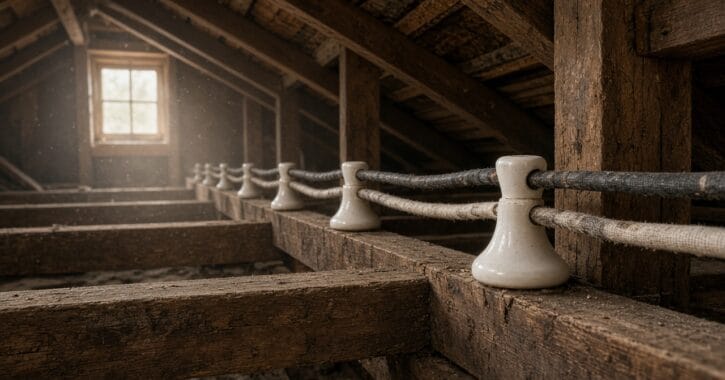
Knob and tube wiring in Chicago is older open wiring from pre-1950 homes. Review knob and tube wiring Chicago inspectors flag before a remodel, added load, a sale, or an insurance request. Condition, live versus abandoned runs, and the panel decide the next step, not the age label alone.
STS Electric inspects knob and tube wiring in Chicago bungalows, two-flats, and small apartment buildings. We map which circuits are still live, which runs were cut dead, and what an insurer or inspector is asking for. Licensed work is dispatched from 939 W North Ave #746. Call (773) 721-1111 to schedule an assessment.
How to Tell If a Chicago Home Has Knob and Tube
Home age is a clue, not proof. Pre-1950 bungalows, greystones, worker cottages, and brick two-flats often started with this system. A later kitchen may already be on newer cable while attic lights stay original.
Safe visual tells, if you can see them without opening a panel or disturbing insulation:
- Porcelain knobs on joists or porcelain tubes through framing in the attic or basement
- Single cloth-covered conductors, not a sheathed cable with a ground
- Two-slot receptacles in several rooms, or a mix of two-slot and three-prong devices
- A fuse panel, or a breaker panel with unlabeled mixed-era circuits
- Inspection language that says “knob and tube,” “ungrounded wiring,” or “obsolete wiring”
Cloth-jacketed NM is a different era. If the question is fabric cable rather than open knobs, start with is cloth wiring safe. Two-slot outlets without a ground path are covered on two-prong outlet replacement.
Do not open the panel or pull insulation to get a photo. A licensed electrician confirms what is still live.
Active Versus Abandoned Knob and Tube
Seeing knobs in an attic does not mean the whole house is still fed that way. Many Chicago properties keep leftover porcelain hardware after some circuits were disconnected.
Active knob and tube still lands on a fuse or breaker and still feeds lights or receptacles. That is the system insurers, buyers, and remodelers care about.
Abandoned runs are disconnected at the source. Knobs may stay in the joist bay. Leaving dead conductors in place is often acceptable when they are confirmed open, labeled, and not reused as a splice point.
The useful question is not “does the house have knobs.” It is which rooms still have live original circuits, and where new cable was tied onto old wire. Hidden joins inside walls decide where a partial replacement can stop.
Chicago Homes Where This Wiring Still Shows Up
Knob and tube wiring Chicago bungalows and brick two-flats still hide in joist bays after a kitchen or basement was updated. Greystones, worker cottages, and older walk-up condos show the same mix: the room looks current, the ceiling cavity does not.
On the bungalow belt, including Portage Park, original lighting circuits are often left in place. See the home electrical wiring guide for how this era sits next to cloth NM and copper. Aluminum from the late 1960s is a separate path on aluminum wiring repair in Chicago.
Chicago Electrical Code for Knob and Tube
For knob and tube wiring Chicago code follows NEC Article 394 without a local rewrite (Municipal Code of Chicago 14E-3-394). Existing installations are recognized. That article does not order every homeowner to rip the system out on sight.
A demand to replace working knob and tube usually comes from an insurer, a buyer, or a remodel, not from that section alone.
Chicago also limits nonmetallic cable (NM, often called Romex). Under 14E-3-334, NM is not the default Chicago rewire method. It is allowed only in narrow cases, including temporary wiring and limited knob-and-tube extensions in existing dwellings up to three stories. New permanent circuits here usually run in steel conduit or listed metal-clad cable, then take a city permit when the scope requires it.
Splices belong in accessible boxes. Missing grounds are a grounding and bonding issue, not a three-prong adapter fix.
When to Replace Knob and Tube Wiring
Plan knob and tube wiring Chicago replacement, or a written phase plan, when any of these are true:
- Live knob and tube is buried under blown-in attic insulation (it needs air to shed heat)
- Kitchen, laundry, window air, or space-heater loads sit on original circuits
- You are opening walls for a remodel, or an insulation contractor is about to cover the attic
- An inspector or insurer flagged active wiring, or you have a short deadline after a purchase
- You want an EV charger, induction range, or other new heavy load
- The panel is a fuse box, is full, or cannot land new grounded circuits
You do not have to replace every abandoned knob you can see. You do need a map of what is still live. Whole-home scope lives on our house rewiring in Chicago.
Knob and Tube Wiring Replacement in Chicago
Knob and tube wiring replacement in Chicago moves with access, not with a national per-foot average. Plaster and metal lath, brick party walls, stacked closets, and whether you stay in the home change the hours more than square footage alone. We do not quote a fake citywide price from this page.
Typical routes for new circuits, once walls and the panel are reviewed:
- Pull new conductors in existing steel conduit if the pipe is sound and continuous
- Run EMT in open walls during a remodel
- Fish listed metal-clad or armored cable when finishes stay up
- Use surface conduit on brick or walls that cannot be fished
A partial replacement can be enough when remaining original circuits test sound and carry light loads only. The risk sits at the boundary. New cable must not disappear into old open wiring inside a wall. After work, the panel directory should say which circuits are still original.
New circuits and many permanent wiring changes need a Chicago Department of Buildings permit. If the panel cannot accept grounded home runs, price electrical panel or service upgrade work with the wiring.
Knob and Tube Wiring, Insurance, and Home Sales
Insurers and buyers treat knob and tube wiring in Chicago as a documented risk. Some carriers refuse a new policy on active K&T, or renew only after a licensed letter. Some give 30 to 60 days after closing to show a plan. Others raise the premium or exclude electrical fire. We do not speak for any carrier.
What we can put in writing:
- Which rooms still have live original circuits
- Which runs were confirmed abandoned
- Visible modifications, open splices, and insulation contact
- Whether replacement, a phase plan, or further opening is recommended
- Our license line and the property address
A letter cannot invent a passed result for circuits we did not open. Photos, the inspection report, and the insurer request help us match the document they asked for.
Warning Signs That Need Urgent Help
Treat these as urgent:
- Burning odor, smoke, sparks, or scorch marks
- Warm outlets, switches, or fixture canopies
- Buzzing at devices or the panel
- Repeated fuse blows or breaker trips on one circuit
- Partial power loss in a room after a heat event
Shut the circuit off if you can do it safely. Leave the building if you see smoke or flame and call 911. Then use our 24/7 emergency electrical service. Chronic heat without an acute event is also on warm outlet or burning smell.
What to Send Before We Visit
Send only what is already visible and safe:
- Photos of knobs, tubes, two-slot receptacles, or cloth conductors in the attic or basement
- A photo of the panel door, and the interior if the cover opens without tools
- Rooms with symptoms, plus any inspection notes, insurance emails, or sale deadlines
- Remodel dates and who will be living in the home during replacement
How an Assessment Works
We start at the panel, then check accessible attic, basement, and device samples. We do not tear plaster on a first visit unless you already planned openings. You leave with a written summary: live versus abandoned, next step, permit needs, and whether panel work should be priced with the wiring.
Frequently Asked Questions
Is knob and tube wiring automatically unsafe?
No. Age alone does not condemn it. Modifications, insulation covering live conductors, overload, brittle insulation, and missing grounds are what turn a working original system into a problem.
Is knob and tube wiring legal in Chicago?
Existing installations are recognized under Chicago’s adoption of NEC 394 (14E-3-394). New work must follow current Chicago electrical code, including the city’s limits on NM cable.
Does Chicago require knob and tube to be replaced?
Not automatically. Replacement is usually driven by insurance, a sale, a remodel, added load, or unsafe condition. The concealed knob-and-tube article does not, by itself, order a full rip-out.
Can it support modern loads or an EV charger?
Original circuits were not designed for today’s kitchens, laundry, HVAC, or vehicle charging. Do not add an EV charger onto live knob and tube. Those loads need new circuits and panel space.
Should I replace knob and tube before remodeling?
Have it mapped before walls, ceilings, or attic insulation change. Open walls are the cheapest time to replace live original circuits. Covering them and then opening again costs more.
Does knob and tube wiring affect insurance or a home sale?
It can. Carriers and buyers care about active wiring, visible alterations, and whether you have a licensed plan. We document what is present so you are not guessing from a one-line inspection note.
Do I need to replace all of it?
Not always. Partial replacement is common when remaining original circuits are accessible, unmodified, and lightly loaded. Buried live runs, insulation contact, and kitchen or laundry circuits usually move first.
How do I know if it is still live or abandoned?
Knobs in a joist bay are not the answer. A licensed electrician traces which conductors still land on an overcurrent device and which were cut dead.
What belongs in an insurance or inspection letter?
Address, license line, rooms checked, live versus abandoned circuits, insulation or splice notes, and a next step. Not a blanket safe stamp for work we did not see.
Schedule a Knob and Tube Wiring Review in Chicago
Call (773) 721-1111 to book a knob and tube wiring Chicago assessment. Say whether you face an insurance deadline, a home inspection, or a remodel so we leave time for panel and attic review on the first visit. STS Electric serves Chicago and Cook County from 939 W North Ave #746.


