


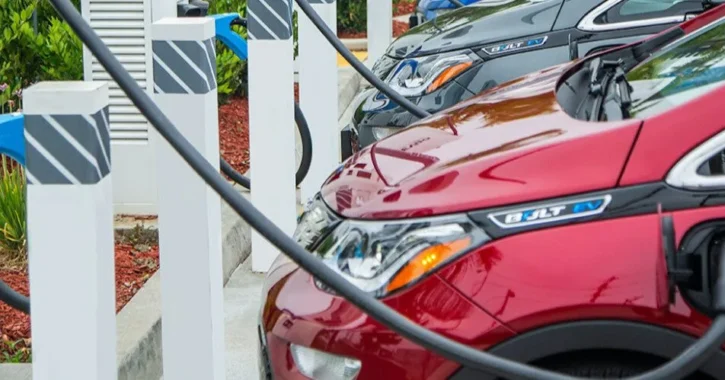
A Chevrolet EV charger in a Chicago home is sized from the car’s onboard charger. A Bolt EV, an Equinox EV, and a Silverado EV can leave the factory with different charge rates, and the wire and breaker have to match that rate. The shared steps for any home charger are covered under EV charger installation in Chicago.
The circuit each Chevrolet needs
The 2023 Bolt EV has an 11.5 kW onboard charger. At 240 volts that is about 48 amps continuous. A charger that runs for hours is a continuous load, so the breaker is sized at 125 percent of the charge rate. Forty-eight amps times 1.25 is 60 amps. This car uses a 60-amp breaker and wire sized for that breaker.
The 2026 Equinox EV lists Level 2 charging up to 11.5 kW, which is the same 60-amp circuit. GM also lists 19.2 kW charging capability for that model. That rate is 80 amps continuous. Eighty amps times 1.25 is 100 amps, so that module needs a 100-amp breaker. We read the charge module on the vehicle, or the window sticker, before we size the wire. Matching the circuit to the badge, instead of the module, is how a 60-amp circuit ends up on a car that can draw 80.
The 2026 Silverado EV lists up to 11.5 kW on the Standard Range. Extended Range and Max Range list up to 19.2 kW. Standard Range uses the 60-amp circuit. A 19.2 kW Extended Range or Max Range uses the 100-amp circuit. These rates are on GM’s 2026 Equinox EV and Silverado EV fleet sheets. The Bolt figure is from Chevrolet’s 2023 Bolt EV specifications.
The Bolt returns as a 2027 model with a native NACS port. GM’s August 13, 2026 port note names that port and leaves the home charge rate to the module on the car in the driveway. We confirm that module before we order wire.
The dryer outlet is a 50-amp circuit
Many Chicago garages already have a NEMA 14-50 outlet for a dryer or a welder. That outlet sits on a 50-amp breaker. A continuous load on a 50-amp breaker stops at 40 amps, about 9.6 kW. An 11.5 kW Chevrolet draws about 48 amps, so it needs the 60-amp circuit. A 19.2 kW truck draws 80 amps. Using the old 14-50 for either car overloads the outlet. We pull a new dedicated circuit back to the panel and leave the dryer outlet on its own breaker.
Hardwired or plug-in
An 11.5 kW charger can be hardwired, or plugged into a receptacle listed for a 60-amp circuit, when the charger maker allows a plug. Most 48-amp wall units we install are hardwired. The receptacle and the plug both have to be rated for the full circuit, and a common 14-50 is the wrong part for a 48-amp continuous load. A 19.2 kW charger is hardwired on the 100-amp circuit. There is no common household receptacle for an 80-amp continuous load.
On a 60-amp circuit we typically pull 6 AWG copper. On a 100-amp circuit we typically pull 3 AWG copper, when the breaker and the charger lugs are rated for 75 degrees C. A long run to a detached garage or an alley pad can move us to the next size so the voltage at the charger stays where the car can use it. Aluminum is a different size for the same breaker, and we only use it where the lugs are listed for aluminum.
The plug on the car
2026 Equinox EV and Silverado EV models still leave the factory with a CCS port. A Level 2 charger with a J1772 plug connects to those cars. A NACS plug at a public station uses GM’s adapter. The 2027 Bolt has a NACS port. A home charger with a J1772 cable needs the matching adapter, or we install a unit that ends in a NACS connector. GM published this split on August 13, 2026. The adapter is a small part. The circuit behind it is the part that has to be right on day one.
What we check in a Chicago home
We review main ampacity, spare breaker spaces, grounding, and the run to the parking spot. A 60-amp breaker and a 100-amp breaker are both two-pole breakers, so each one needs two spaces. What changes is the load. A 100-amp circuit asks the service for 80 amps of continuous room after the range, the dryer, the air conditioning, and the heat. Older bungalows, two-flats, and remodeled kitchens often have less spare capacity than owners expect. Start with a panel check to see whether your panel can handle an EV charger.
A 100-amp Silverado circuit is the job that most often leads to an electrical service upgrade before the charger goes on the wall. A full 100-amp or 150-amp service has no spare room for an 80-amp continuous load beside an electric range. A 60-amp Bolt or Equinox circuit gets the same load review. On some 200-amp services that 60-amp circuit fits in open spaces. On a full 100-amp service the math fails, and we say so before anyone buys the wall unit.
Where the Chevrolet parks
A Bolt or an Equinox usually sits in a garage or on a short driveway, and the cable only has to reach a few feet from the wall. A Silverado EV is a full-size truck. Alley garages, detached garages, and street-side pads change the run. We measure from the panel to the charge-port door. The bumper someone points at on the first call is often the wrong end of the truck. If the port is on the front corner, a charger mounted on the back wall of a coach house can leave the cable short.
Outdoor mounts use wet-location equipment, a cover that closes around the coupler, and conduit where a loose cable would lie in the alley. A driveway pedestal is a longer run, either in a trench or in surface raceway along the foundation. The breaker size stays the same. The wire size can go up when the run is long. Indoor garages in two-flats often share a panel in the basement, so the new circuit has to be fished up through finished ceilings. That path, more than the charger brand, is what sets the labor.
Buildings with their own rules
Associations and landlords may require written approval, a preferred charger brand, or a meter of its own. A shared garage also needs a clear owner for the new circuit, so one neighbor’s car is fed from that neighbor’s breaker. Bring the building rules to the walkthrough. We can say what is electrically possible. The association or the property manager still grants the approval. If the rules cap the charger at a lower rate than the car can accept, we size the circuit to the cap and set the charger to match, and we write that limit on the scope.
The City of Chicago requires a permit when its rules say the work needs one. Wire size, breaker rating, labeling, and outdoor-rated equipment are part of that inspection. A Chicago permit stops at the city line. Towns around Cook County use their own permit desk. We file the permit when that jurisdiction requires it. The breaker gets a label that names the car circuit, so the next person in the panel can see what it feeds.
What happens on the visit
On the visit we confirm the onboard charger, open the panel, and walk the path to the parking spot. If the service can take the load, we install the dedicated circuit, mount the listed charger, land the conductors, label the breaker, and run a charge before we leave. If the panel is short, the visit ends with a written scope for the service work, and the charger stays in the box until that work is done. An 80-amp truck charger waits until the load review passes.
STS Electric installs these circuits for Chevrolet EVs across Chicago and Cook County. For scheduling and scope, see our electric vehicle charging station installation. Call (773) 721-1111 to set a panel and site visit.


