


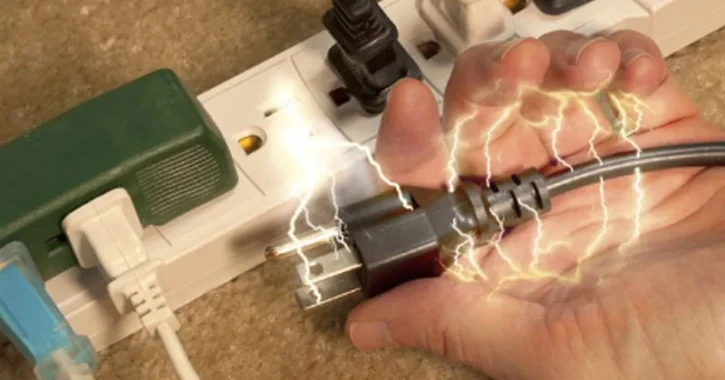
A person who is still holding a live cord, or still touching a tool that is buzzing, is part of the circuit. Do not grab them. Do not pull the cord out of their hand. Shut the breaker off if you can reach the panel without touching them. If you can unplug a power strip from the wall without touching the person, do that. Then call 911. Leave that circuit off.
The photo is a staged picture of a hand on a plug at a power strip, with sparks drawn on. A real shock does not look like drawn lightning. A cord that sparked stays unplugged.
A direct injury is current through the body
Current that passes through a person is a direct injury. The mild end is a sharp jolt and a burn on the skin. Muscles can clamp onto the cord so the hand cannot let go. Current across the chest can disturb the heart’s rhythm. When the shock kills, it is called electrocution.
The burn is often where the current entered and where it left. A small mark on a finger can sit over a deeper burn. That is a reason to stay on the line with 911. It is not a reason to rinse the hand and turn the breaker back on.
Household 120 volts is enough to do this. A damp floor, a wet hand, or a missing equipment ground makes a path easier. A new faceplate does not repair a circuit that just shocked someone.
An indirect injury happens because of the shock
The current does not have to be the wound. A muscle contraction can throw a person off a ladder, off a step, or back into a sink. The fall is the injury. A spark at a damaged cord can light a curtain, a rug, or the insulation in the box. The fire is the injury.
On a job site, an arc from a live panel can burn a worker and can knock them down. NFPA 70E is the workplace electrical safety standard for that kind of work. It is not the code for a Chicago house. A house is repaired with the circuit off.
Four results of contact with electricity
OSHA groups these results as electrocution, shock, burns, and falls. Electrocution means the person died. Electric shock means current passed through the body and the person survived. Burns are the heat at the contact points, and sometimes along the path inside the body. A fall is the indirect injury: the shock caused the person to lose the ladder or the step.
In a Chicago house the calls are usually the shock, the burn on a hand, and the fall. A fatal shock is uncommon at home. It is still the reason the breaker stays off until the fault is found.
What shows up in Chicago homes
A cord with a cracked jacket. A plug that is warm. A power strip plugged into another power strip behind a sofa. An outdoor outlet with no GFCI. A bathroom outlet that should have tripped and did not. A three-prong adapter jammed into a two-prong outlet. A drill used on a damp basement floor.
Kitchens, bathrooms, garages, basements, and outdoor outlets need GFCI protection. A GFCI that does not open when it should is a failed device, not a quirk. Water on the floor and a metal tool make the same outlet more dangerous than it was when the room was dry.
A hot outlet is a fire path. It is also a shock path if the face is cracked or the ground is open. Leave the cover on. Two-prong outlet replacement is the job when no equipment ground is present. The repair is a GFCI marked No Equipment Ground. A jumper from the neutral to the ground screw is not a ground.
An extension cord is a temporary cord, not a permanent circuit. A cracked cord that shocked someone gets unplugged and stays out of service. The wall outlet still gets checked, because the fault may be in the box and not only in the cord. Do not keep using a tool that shocked someone once. The cord, the outlet, or the tool has a fault.
What to do
Do not touch the person while they are still in contact with the cord, the tool, or the outlet. Shut the power off only if you can do it without touching them. Call 911 and stay on the line. Do not turn the breaker back on to see if the sparking stopped.
After the person is in care and the circuit is off, call STS Electric at (773) 721-1111. We serve Chicago and Cook County day and night. The visit finds the fault before that circuit is turned on again. Call for electrical repair service when a cord, an outlet, or a tool shocked someone.
After the emergency
A breaker that is off stays off if there are burn marks, a smell of hot plastic, or a GFCI that failed to open in a wet room. Resetting it and plugging the same cord back in repeats the fault. The repair checks the device, the cord, and whether that circuit has a ground and the protection it should have.
If the visible harm is a fall, and the person is already with medics, the circuit still gets checked. A shock strong enough to knock someone down was strong enough to damage the cord or the outlet. Turning it back on before that check is how a second person gets hurt.


